
The MarTech solutions market continues to grow at a rapid pace. MarTech tools have never been more numerous, more powerful… or more complex to activate.
Analytics platforms, research software, social listening solutions, feedback management systems, AI-driven marketing tools, organizations are investing heavily in technology to better understand their markets and guide their decisions.
Yet a recurring reality is emerging on the ground: the tool is in place, but the value has not fully materialized.
Why?
Because value is not created by the solution itself, it is created through integration and activation.
The Growth of MarTech Tools Is Reshaping the Market
The numbers speak for themselves: software solutions related to data, analytics, and insights (MarTech) are now the primary growth driver of the industry.
According to the ESOMAR Global Market Research 2024, research software and digital data analytics are experiencing double-digit growth, significantly outpacing traditional services.
The market is becoming increasingly structured around highly specialized tools capable of processing growing volumes of data and integrating AI components.
However, this acceleration comes with a side effect: MarTech stacks are becoming increasingly fragmented, and increasingly complex to manage.
In practice, this often results in:
- Tools selected quickly, sometimes under pressure
- Partial or improvised integrations
- Teams insufficiently supported in adoption
- A value promise that takes time to materialize
Why MarTech Integration Is Becoming the Real Strategic Challenge
Contrary to a still common assumption, the main issue is not tool quality.
The friction point lies between:
- Business objectives
- Product capabilities
- And the operational reality of teams
This is precisely where value creation happens.
Yet neither MarTech solution providers nor internal client teams are structurally positioned to bridge this gap alone:
- Vendors focus on product, sales, and marketing.
- Internal teams often lack the time, perspective, or hybrid skills needed to orchestrate the whole ecosystem.
The result: a growing need for an intermediary role capable of connecting the dots.
The Key Role of Freelancers in MarTech Integration
Within this context, a still loosely defined but increasingly central role is emerging: the freelance MarTech integrator.
A Simple Definition
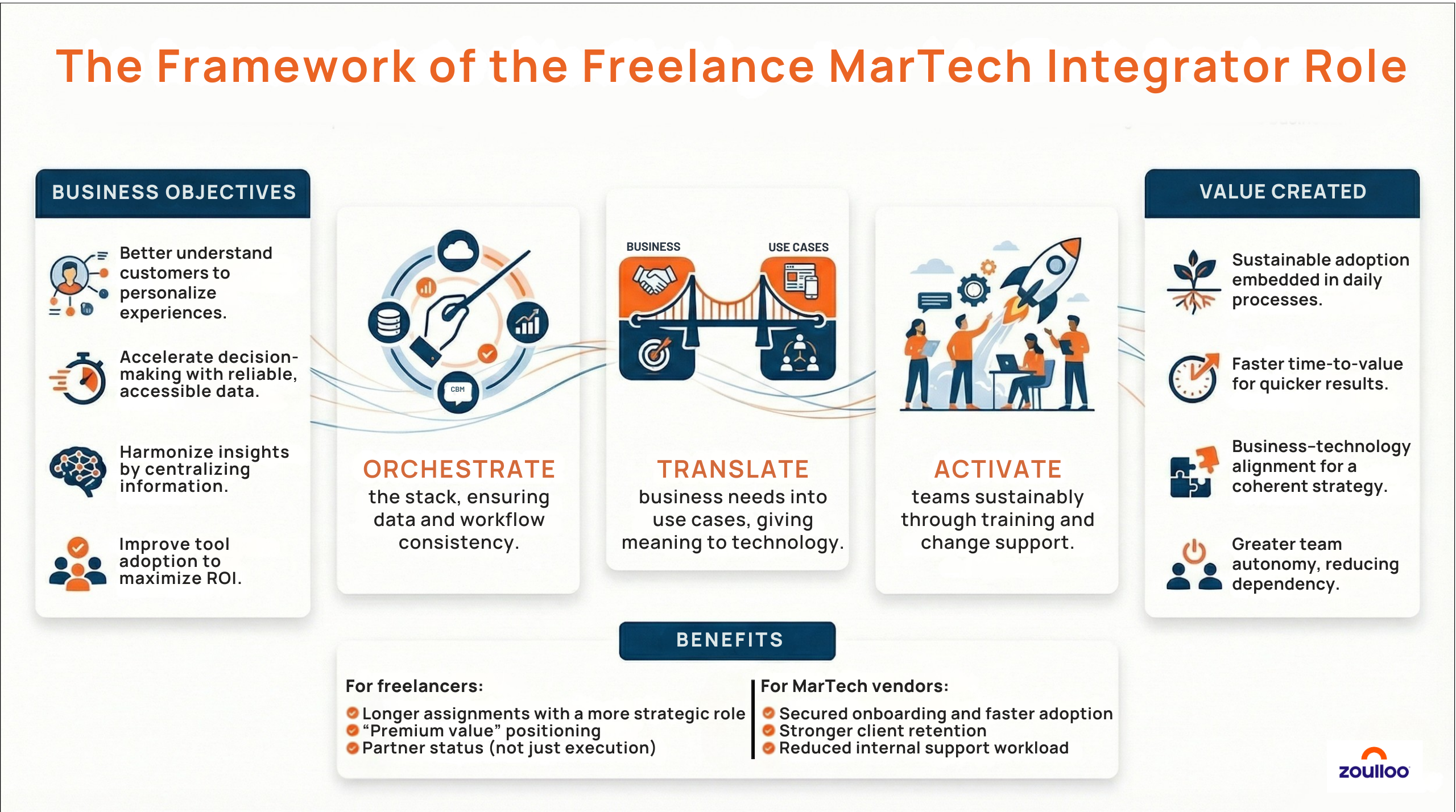
The freelance MarTech integrator is a value orchestrator.
Their role is to transform a MarTech solution into concrete usage, and then into measurable business impact.
They are:
- Not merely a tool expert
- Not a traditional project manager
- Not a strategic consultant disconnected from operations
Instead, they embody a hybrid role at the intersection of technology, business, and people.
The Three Pillars of MarTech Integration: Orchestrate, Translate, Activate
To better understand this role, it can be structured around three complementary pillars.
1. Orchestrating the MarTech Stack
The integrator’s first mission is to create coherence.
In environments where tools multiply, the goal is not to add another layer, but to understand:
- What already exists
- How tools interact
- Where real value opportunities lie
The freelance MarTech integrator acts as a pragmatic architect:
- Prioritizing integrations that truly matter
- Anticipating technical and organizational friction
- Securing data flow across systems
The value created here is immediate: reduced redundancy, improved clarity, and accelerated time-to-value.
2. Translating Business Objectives into Concrete Use Cases
A MarTech tool only has value if it serves a clear objective.
The second pillar consists of bridging business and technology:
- Reframing the company’s real challenges
- Translating them into actionable use cases
- Configuring the solution accordingly, not the other way around
This is often where projects derail, due to unclear translation between business expectations and product capabilities.
The integrator acts as a mediator between business stakeholders and product teams.
This translation capability is what distinguishes an integrator from a purely technical profile.
3. Activating Teams and Securing Adoption
No MarTech project succeeds without adoption.
The third pillar, often underestimated, is human activation:
- Team onboarding
- Training and pedagogy
- Change management support
- Progressive upskilling
The goal is not to create dependency, but autonomy.
Without this pillar, the tool remains installed. With it, it becomes embedded in daily practice.
On the ground, this role takes very concrete forms in MarTech freelance assignments:
- Stack orchestration:
In several recent projects, companies already had powerful tools in place, but poorly articulated. The freelancer audited the existing setup, prioritized meaningful integrations, and coordinated internal teams and vendors to make the stack fully operational. - Business translation:
In other cases, the tool had been selected before use cases were clearly defined. Freelancers stepped in to clarify business objectives, define actionable use cases, and configure solutions accordingly, preventing feature underutilization. - Team activation:
A significant share of assignments focuses on onboarding and adoption. Training, pedagogy, and change support often prove decisive in turning a MarTech solution into a sustainable performance driver.
MarTech Integration as a Differentiation Lever for Freelancers
For freelance talent, this role opens new perspectives. Rather than positioning themselves solely as experts of a specific tool or niche component, they can:
- Engage in longer, more strategic assignments
- Position themselves on high-value challenges
- Become trusted partners for clients, and vendors alike
In a market where pure specialization sometimes reaches its limits, orchestration becomes a powerful differentiator.
Integration: A Sustainable Value Lever for MarTech Vendors
For vendors, the stakes are equally strategic.
A client who fails to activate a solution is a fragile client:
- Low adoption
- Potential churn
- A weakened product promise
Relying on freelance MarTech integrators helps:
- Secure onboarding
- Accelerate value creation on the client side
- Improve satisfaction and retention
The freelance integrator is not a peripheral contractor, but an activation partner.
MarTech Integration: Toward a More Collaborative Model
The rise of MarTech tools does not signal the end of human roles, quite the opposite.
It creates a new need: profiles capable of connecting technology, business, and teams.
By structuring, clarifying, and elevating this role, the MarTech ecosystem can gain maturity:
- For client organizations
- For vendors
- And for freelancers seeking high-impact assignments
At zoulloo, this is precisely the philosophy guiding how we support talent and companies: connecting the right profiles with the right projects, at the right time, turning complexity into value.